 Mission HillsCroquet Club
Mission HillsCroquet Club
Mission HillsCroquet Club

The Long Game, at Its Finest.
Played around the world under international rules, and the game of the MacRobertson Shield.
Association Croquet, also called International Rules, is played on the same court as Six-Wicket, with the same hoops, peg and scoring. What changes is how much freedom each turn gives you.
You may play either of your two balls each turn, and every ball becomes live again at the start of your turn. That freedom lets skilled players build long "breaks," using the other three balls to travel around the whole court in a single visit. It is the game of the MacRobertson Shield, the sport's premier international team event. The US Open Invitational in December and the Desert Classic in January are played under Association rules.
The court is 35 by 28 yards, with six hoops and a peg at the center. It can be scaled down for an ordinary lawn. Each ball runs the six hoops in order, then the same six in reverse, finishing on the peg. The last six hoops have names of their own: 1-back, 2-back, 3-back, 4-back, penultimate and rover. The corners are numbered I to IV, clockwise from the southwest, and each carries a flag in one of the ball colors.
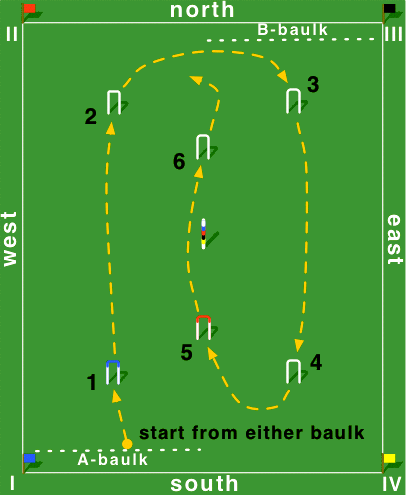 Diagram: U.S. Croquet Association
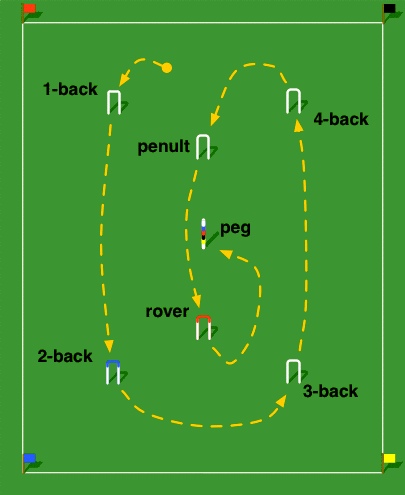 Diagram: U.S. Croquet Association
The winner of a coin toss chooses whether to play first or second, and the opponent then picks colors. In singles each player plays two balls. In doubles each keeps the same ball all game.
Balls are played into the game from anywhere on either baulk line, and all four must come in during the first four turns.
Turns alternate between the sides. Once both of your balls are in play, you choose which one to play each turn.
A ball scores by passing through its next hoop in the right direction. Clips show each ball's progress, on top of the hoop for the first six points and on the side for the rest.
A ball is out as soon as any part of it crosses the boundary. It comes back in one yard from where it went out.
A ball that has run all twelve hoops is a "rover" and can score the peg point. The game ends when both balls of one side have been pegged out.
Hit a live ball and you've made a roquet. You then place your ball against it and play a croquet stroke, moving both balls at once.
You earn an extra stroke for running a hoop, or after playing a croquet stroke. Linking them together is what builds a break.
Once you roquet a ball, it's dead to you until your ball runs its next hoop, or until your next turn begins. That fresh start each turn is what sets Association apart from the American game.
In handicap play the weaker player receives "bisques," extra turns to use whenever they like, so players of different levels can enjoy a close game.
Association is the long, tactical game at its finest. The US Open Invitational in December and the Desert Classic in January are played under Association rules, with one lawn kept free for members. Our more experienced members play it through the season, and our Club Pro is always glad to talk tactics.
This guide is our own summary. For the official version, see the USCA's Association Croquet synopsis and the full USCA rulebook.