 Mission HillsCroquet Club
Mission HillsCroquet Club
Mission HillsCroquet Club

Precision, Patience and a Plan.
The USCA's traditional game, where a single well-planned turn can carry a ball around the court.
American Six-Wicket croquet is the game most Americans picture: two sides, two balls each, around a course of six wickets twice and onto the stake. The difference from the backyard game is in the extra strokes.
Run a wicket or hit another ball and you earn more shots, so a skilled player can string together a long turn, using the other balls as stepping stones. Keeping track of which balls you've already used, called deadness, is the strategic heart of the American game. Mission Hills hosts the USCA Western Region tournament in this format each March.
The standard court is 35 by 28 yards, with six wickets and a stake at the center. Smaller backyard courts work too. Each ball runs the six wickets in order, then the same six again in reverse, twelve wicket points in all, before finishing on the stake. The corners are numbered I to IV, clockwise from the southwest, and each carries a flag in one of the ball colors.
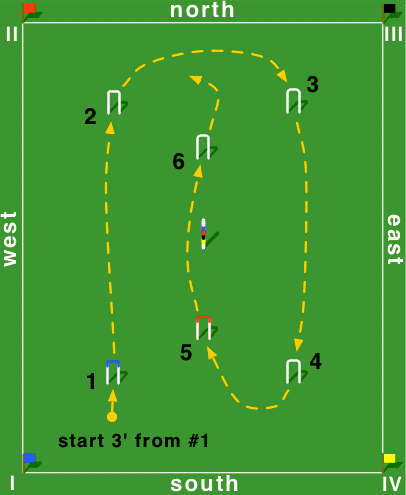 Diagram: U.S. Croquet Association
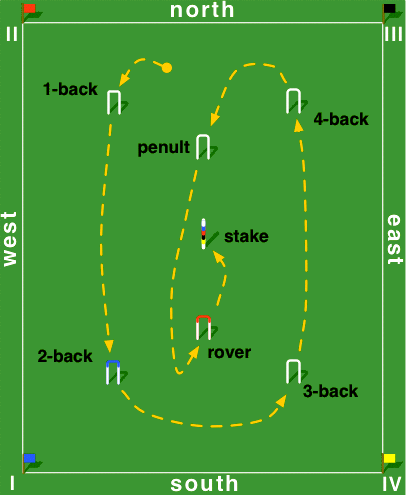 Diagram: U.S. Croquet Association
The winner of a coin toss chooses to play first with blue and black, or second with red and yellow. In singles each player plays two balls. In doubles each player plays one.
Each ball comes into the game from the starting tee, 3 feet south of wicket 1.
Balls are played in strict rotation: blue, red, black, yellow, throughout the game.
A ball scores by going through its next wicket in the right direction. Colored clips on each wicket show where every ball is on the course: on the crown for the first six points, on the side for the rest.
A ball is out once its center crosses the boundary line. It comes back in nine inches from where it went out.
When a ball has run all twelve wickets it becomes a "rover." A rover that hits the stake has scored the stake point and leaves the game. The first side to stake out both balls wins.
When your ball hits another ball, that's a roquet, and it earns you a croquet stroke. You can't roquet before your ball has run the first wicket, or hit a ball you're already dead on.
Pick up your ball and set it touching the ball you just hit. Then strike your ball so that both move. Skilled players use this stroke to send one ball where it's useful and their own toward the next wicket.
Running a wicket earns one extra stroke, and so does playing a croquet stroke, as long as no ball went out of bounds. Running two wickets in one stroke still earns only one extra stroke. Your ball can't score a wicket and make a roquet on the same stroke; whichever happens first counts.
After you croquet a ball, you're "dead" on it: you can't hit it again until your ball runs its next wicket. Unlike the international game, deadness carries over from turn to turn, so players track it on a deadness board beside the court. Rovers clear their deadness by going through any wicket in any direction.
Six-Wicket is our tournament game. Mission Hills hosts the USCA Western Region tournament in this format each March, and members play it through the season in club events and on the Club Ladder. Once you're comfortable with Golf Croquet, our clinics will walk you into it.
This guide is our own summary. For the official version, see the USCA's Six-Wicket Croquet synopsis and the full USCA rulebook.